
ZHONGSHAN, China
In a move underscoring the growing economic ties between Africa and China, a high-level delegation from the African Global Business Chamber concluded a strategic visit to Zhongshan’s premier industrial and innovation hubs on January 15th 2026. The tour, focused on cross-border e-commerce, industrial incubation, and youth entrepreneurship, highlighted potential pathways for collaborative ventures and knowledge exchange.
Accompanied by Zhang Baohua, President of Huizhi Group, the delegation began its itinerary at the E-Park Investment Promotion Centre. Here, the model of integrated services, spanning policy advocacy, resource matching, and infrastructure, were presented not merely as administrative support, but as a critical ecosystem driver for enterprise growth. Delegates noted the park’s deliberate cultivation of an open, inclusive, and collaborative environment, a factor they identified as essential for modern industrial agglomeration.
The practical application of this ecosystem was immediately apparent at Guangdong Latemet E-Commerce Co., Ltd., a cross-border brand accelerator. The company’s project-driven, metrics-oriented approach to launching Chinese brands globally provided a tangible case study in scalable export strategy, a subject of keen interest to the Ghanaian representatives, whose economy is increasingly focused on value-added exports.
A focal point of the exchange was the Zhongshan Guangdong-Hong Kong-Macao Youth Innovation and Entrepreneurship Cooperation Platform. The delegation examined its public-benefit model, mentor network, and full-chain incubation services. The platform’s leveraging of the Greater Bay Area’s unique resources to de-risk and empower startup ventures offered a replicable framework for youth entrepreneurship support, a priority for many African economies.
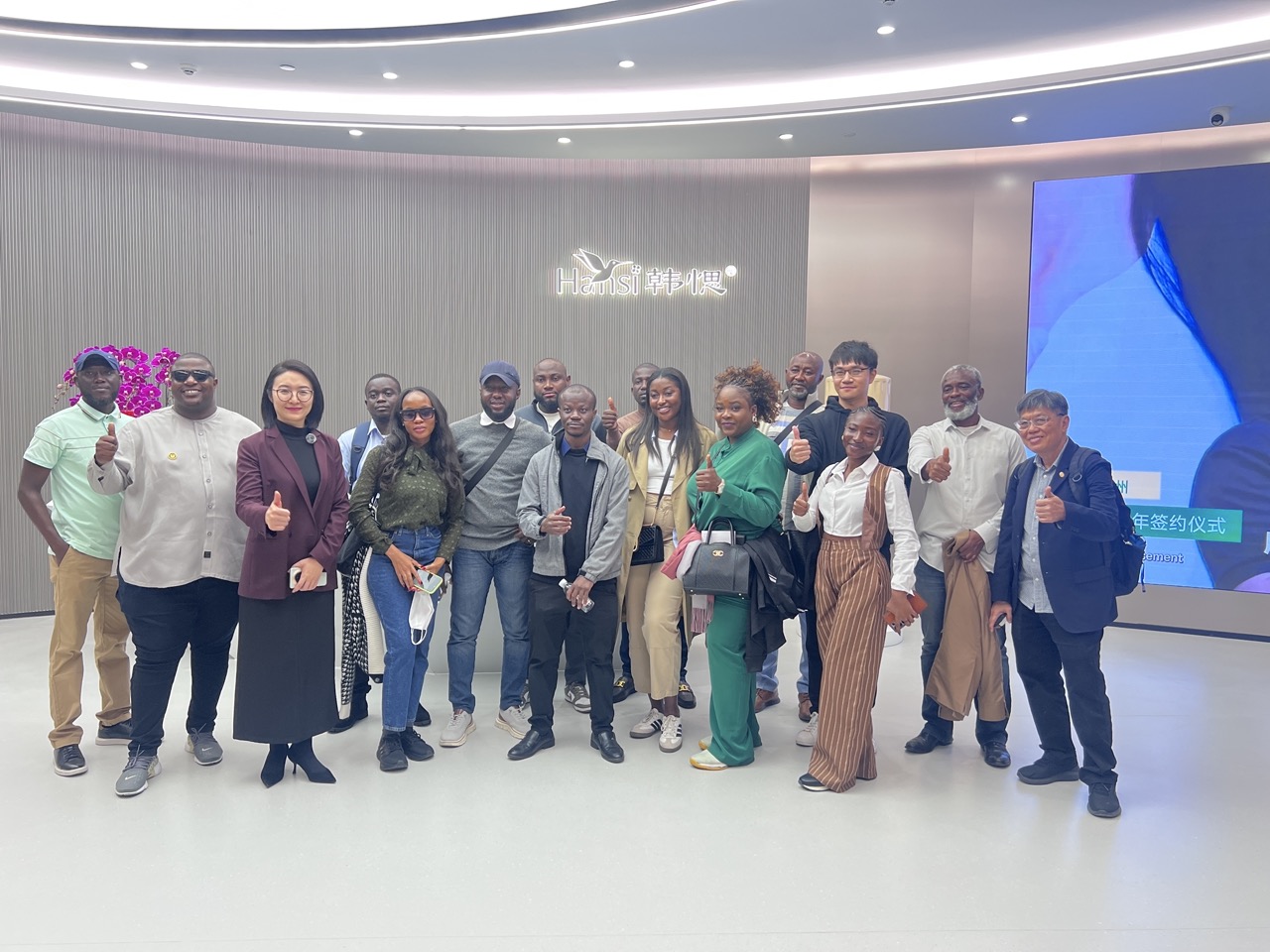
The tour of the E-Park E-Commerce Headquarters Building revealed a dedicated ecosystem for digital commerce, from R&D to final sales. The visit to anchor tenant Hansi, a dominant player in China’s online hair dye market, illustrated a successful narrative of brand specialization meeting industrial support. Hansi’s recent relocation and expansion into the building was cited as evidence of the symbiosis between mature enterprises and upgraded cluster facilities.
A Bridge for Mutual Growth
For the African Global Business Chamber, the visit was less a passive inspection and more an active sourcing of models and partners. “What we witnessed today transcends industrial park logistics,” noted Kimberly Sarpong, the vice president of the chamber. “It is a comprehensive blueprint for integrating policy, capital, talent, and market access. The potential for applying these principles to foster Ghanaian and African enterprises, particularly in e-commerce and light manufacturing, is substantial. This is about building a two-way bridge for innovation and investment.”
The engagement laid groundwork for prospective cooperation in several key areas, from leveraging Chinese e-commerce platforms and logistics expertise for African exports, establishing sister-incubator programs for young entrepreneurs, and facilitating direct B2B linkages in consumer goods and technology.
The delegation’s presence signals a strategic shift in Africa-China economic dialogue, moving beyond broad infrastructure into the granular realms of SME growth, digital trade, and entrepreneurial capacity building, a collaboration where each side brings distinct advantages to a shared table of innovation.